
Be an ISO Outreach volunteer and help make SCA YouTube videos for our channel. Our next project is to make short (2-3 minute) videos on your shares about Chapter 2: The Twenty Questions (from our Big Book). I would like your input (either audio or text) on any of the following questions. You can send it to me either on here scannereditor@sca-recovery.org or at outreach@sca-recovery.org. Your voice and personal information will not be used and your content may be edited . Please consider helping us out by sharing your experiences, hopes and program tools that may have helped you with the question: Chapter 2: Twenty Questions
1. Do you frequently experience remorse, depression, or guilt about your sexual activity?
2. Do you feel your sexual drive and activity are getting out of control? Have you repeatedly tried to stop or reduce certain sexual behaviors but inevitably found that you could not?
3. Are you unable to resist sexual advances or turn down sexual propositions when offered?
4. Do you use sex to escape from uncomfortable feelings such as anxiety, fear, anger, resentment, guilt, etc., which seem to disappear when the sexual obsession starts?
5. Do you spend excessive time obsessing about sex or engaged in sexual activity?
6. Have you neglected your family, friends, spouse, or relationship because of the time you spend on sexual activity?
7. Do your sexual pursuits interfere with your work or professional development?
8. Is your sexual life secretive, a source of shame, and not in keeping with your values? Do you lie to others to cover up your sexual activity?
9. Are you afraid of sex? Do you avoid romantic and sexual relationships with others and restrict your sexual activity to fantasy, masturbation, and solitary or anonymous online activity?
10. Are you increasingly unable to perform sexually without other stimuli such as pornography, videos, “poppers,” drugs/alcohol, “toys,” etc.?
11. Do you have to increasingly resort to abusive, humiliating, or painful sexual fantasies or behaviors to get sexually aroused?
12. Has your sexual activity prevented you from developing a close, loving relationship with a partner? Or have you developed a pattern of intense romantic or sexual relationships that never seem to last once the excitement wears off?
13. Do you only have anonymous sex or one-night stands? Do you usually want to get away from your sex partner after the encounter?
14. Do you have sex with people with whom you normally would not associate?
15. Do you frequent apps, websites, clubs, bars, adult bookstores, restrooms, parks, and other public places searching for sex partners?
16. Have you ever been arrested or placed yourself in legal jeopardy for your sexual activity?
17. Have you ever risked your physical health with exposure to sexually transmitted diseases by engaging in “unsafe” sexual activity?
18. Has the money you spent on pornography, videos, web-camming, apps, phone sex, or hustlers/prostitutes strained your financial resources?
19. Have people you trust expressed concern about your sexual activity?
20. Does life seem meaningless and hopeless without a romantic or sexual relationship?
Tag: outreach
I am Powerless but not Helpless
I’ve told this story before, and it has evolved as I understand it more and more. I hope this is a faithful telling of my experiences. I hope you might find something in it that you can relate to.
Before I knew I was gay, definitely before I ever accepted it, I had another identity that eclipsed everything else. As a young teen, I wasn’t the most cautious about clearing my search history and by 14 my parents confronted me about my “deviant” online behavior. You’d think a couple of adults who found a teenager’s online gay porn collection would conclude this was a pretty clear indication of my homosexuality. For my conservative Mormon parents, it didn’t mean I was gay at all, it meant I had broken my brain. I was clearly just sick, influenced, corrupted. It was impossible, or, more accurately unacceptable, to be gay. We needed a scapegoat, a diagnosis, something to fix. Enter porn addiction. This became the epicenter of my life and my only real identity; porn addict.
I don’t really think this was an incorrect label. The combination of shame, repression, trauma, and denial fueled my compulsive relationship to porn. However, this label was not given out of serenity, courage, or wisdom. It was a scapegoat, a smokescreen, and a mask. It gave me, my family, my church, everyone something to say and permission to keep the rest unsaid. It was more of a gag order than an authentic admission.
For most of my young life, I was terrified that if people saw the full truth about being gay, I would lose love, safety, and belonging. Instead of learning how to be honest, I learned how to hide, manage perceptions, and tell people what I thought they needed to hear. Over time, dishonesty stopped feeling like dishonesty to me. I convinced myself that as long as I meant well, intended to change, or eventually “fixed” things, I wasn’t really lying. That mindset hurt people I loved, but mostly it damaged my ability to connect authentically with people. From a young age, I would split myself in two and only show people the half I wanted to. I don’t think there is any way to do that and not feel broken.
A lot of my unhealthy behavior became tied up with shame, secrecy, fear, and, of course, compulsive sexual behavior. For years, I understood all of that through the lens of addiction. Specifically, the version of addiction and recovery that the Mormon faith prescribed. Later, after coming out and doing trauma therapy, I genuinely believed I had healed the deeper issue underneath it. In many ways, I had. Parts of my life became healthier and freer than they had ever been before. I abandoned the label of addiction and felt vindicated doing so. I wasn’t a porn addict, I had been hurt and traumatized. This new shoe fit, and wearing it was a huge relief. The relief of being able to walk away from the label of addict is part of why it was so hard for me to admit when things started getting bad again.
Moving on with my life I went back to school to study clinical counseling and become a therapist. I met a beautiful, kind man and feel deeply in love. Around 10 years after coming out, if you looked at my life from the outside you’d see a great job, an attractive husband, a close group of friends, a cute home, a lazy dog and a mischievous cat. I was also so deeply entrenched in compulsive sexual behavior that my life was becoming totally unmanageable.
When my ex would catch me in lies, it felt like my world was collapsing. I eventually found a therapist and, after describing my behavior honestly, he said “yeah, sounds like sex addiction.” I hated hearing that. I did not want it to be true. I think part of me felt that if I accepted it, it meant I was fundamentally broken all over again. So even after recognizing I had a serious problem, I stayed in some kind of denial for a long time. Looking back, I think I started living in two contradictory realities at once. On one hand, I was terrified of losing the people I loved, which made me hide more, lie more, and avoid honesty at all costs. On the other hand, I felt safe and deeply loved in my life and relationships, and that safety became part of how I justified my behavior to myself. I kept believing I could contain everything, manage it privately, and eventually stop before the consequences became real. I couldn’t.
The old rules I had lived by had come back in full force: tell people what they want to hear, and never allow yourself to sit with pain, fear, shame, or discomfort for longer than you have to. Whenever I felt exposed, anxious, guilty, lonely, or ashamed, I reached for something that would numb me or make me feel temporarily free. The more dishonest I became, the more shame I carried. The more shame I carried, the more compulsive my behavior became.
It began with sexting and hiding it. Then camming and lying about it. When my ex told me it was hurting him and making him feel unwanted and unimportant, I promised to stop. I promised to stop every time he asked me to. I did not. I repeatedly chose secrecy over honesty, even while watching the damage it was causing.
Over time, the behavior escalated further into cheating, anonymous hookups, cruising, and increasingly risky and compulsive behavior. I would binge, immediately try to shut the shame down with avoidance, denial or justification, promise myself it was over, and then repeat the cycle again. I became increasingly compartmentalized; split in two all over again. I would act in ways that violated my values and harmed people I loved, then try to shut the door on it emotionally and pretend everything was normal.
One difficult truth I have had to confront is that a lot of my compulsivity became tied to transgression itself. Basically, I got hooked on breaking a rule, or the feeling of doing something I “shouldn’t.” As a kid growing up in shame and repression, even small forms of sexual expression felt dangerous, forbidden, and emotionally charged. I remember shaking so hard my teeth would chatter just from typing something erotic in a search bar. I think over time my brain became wired to seek intensity, secrecy, and risk. As my shame around sexuality decreased in healthier ways, my compulsivity adapted by seeking other forms of intensity and rule-breaking instead. I used to try to dismiss these instincts as sexual quirks and pass them off with jokes. That does not excuse what I did. The powerlessness I felt makes it more heartbreaking to me, not less.
As things escalated, I became desensitized to behavior and content that I always recognized as deeply unhealthy, risky, and inappropriate. I was unwilling to admit how unmanageable my life had become. Toward the end, there were moments where I barely recognized myself or the life I was living. I can only imagine how disturbing and disorienting it must have been for the people around me when those realities came to light. I also understand that the deepest harm was not only the sexual behavior itself, but the deception.I repeatedly denied reality to people who trusted me. I did not trust anyone to see my whole life. I manipulated situations to preserve my own safety and avoid consequences. I made people question their instincts, their trust, and their understanding of our relationship.
In all the work I have done to learn and heal, there has been one piece that I have struggled the most to accept: porn addiction was just the tip of the iceberg to my deeper codependency and love addiction. I hated that term. How could love be the problem? Porn and sex were the problem, love was the solution! Wasn’t it? My entire life I had treated compulsive sexual behavior like my one and only problem. What I didn’t notice was that I never really saw changing my behavior as the solution. The solution was my relationships. I saw everyone around me as better, more righteous, more worthy. I didn’t need to change, I just needed to earn more love. Growing up, I saw my family and church communities as saviors. Everyone became a surrogate for God and atonement. They were perfect, I was broken. It wasn’t my role to recover, it was my role to be ruined.
I remember one particular session I had with the first real therapist I had who introduced me to trauma therapy. I must have been really down on myself that day because she stopped me and asked “R—–, why are you trying so hard to convince me that you are a bad person?” My answer was “because if I’m not, the people I love hurt me for no reason.”
If I wanted people to be perfect saviors, I needed to be the perfect sinner. As beautiful as my marriage, my ex, my job, and my friends all were, I didn’t notice that I had fallen into the trap of turning them into perfect saviors. I lifted up the fantasy of my life and began denying myself and my authentic experience. I stopped thinking as a “me” and only thought in terms of “we.” I became more and more codependent to that dynamic and more and more entrenched in all of my old maladaptive coping strategies. I didn’t realize how desperately I began to want to be rescued, just as I had when I was young. The problem with wanting to be rescued, is you need to believe you are helpless. You need to foreclose on every strength, value, and even authenticity. If you really want to be rescued, you have to prove you need to be. In this whole process, it was the hardest to let go of the desire to be rescued. Now, I know I am powerless but not helpless. I cannot do this alone, but no one will do this but me.
Looking for SCA Members with 6 months or more sobriety to go to Las Vegas
to man our booth at the SASH (Society for the Advancement of Sexual Health) 2026 Annual Conference, October 22-23. Please contact us (sca.iso.outreach@gmail.com) if you would like to be of service to SCA and the professional community. The conference will be held at the at the UNLV Campus in Las Vegas, NV. and attended by mental health professionals, medical professionals, researchers, educators, advocates, and students from across the world.
Can You Recognize Your Own Denial?
from a blog by Scott Brassart on December 29, 2025
One of the interesting things about addiction is that most addicts think they don’t have a problem. They think, Sure, if someone else was engaging in the same behaviors that I’m engaging in, that person would have a serious issue, but it’s OK for me because…
This is their denial.
Generally speaking, denial is a series of internal lies and deceits that manifest externally. In other words, addicts lie to themselves first, and then to others. It is lying to themselves that is most important because, based on that imperfect foundation of manufactured truth, their behaviors seem utterly reasonable to them in the moment of their obsession. Outsiders can easily dismantle this house of cards, but addicts cannot (or will not). They repeatedly defend their manufactured truth (their lies and deceit) until their world disintegrates into one crisis after another after another. And even then, they don’t give up easily.
With addiction, denial takes several different forms, the most common of which are listed below.
- Blame/Externalization: My partner has gained a lot of weight since we got married, and that’s unattractive to me.
- Entitlement: I work hard and I support my family, so I deserve to have some fun.
- Justification: If I was in a relationship, I’d be having sex all the time, so why can’t I be sexual all the time when I’m single?
- Minimization: All I’m doing is snorting a little cocaine when I have sex. It’s not like I’m using meth or injecting.
- Rationalization: Everybody looks at porn and plays around with hookup apps. That’s just life in the modern world.
- Victim Mentality: Everybody wants so much from me. I just feel overwhelmed and at the mercy of everyone in my life. And my only relief, the only time I feel in control, is when I’m using porn.
To combat denial, addicts must first uncover the lies they tell themselves (and then others). Then they must reframe those lies into truth by using responsible language. Typically, healing from sex addiction, porn addiction, and paired substance/sex addiction presents challenges that can’t be dealt with solely in one-on-on therapy. In fact, most sex, porn, and substance/sex addicts require external reinforcement and support from fellow recovering addicts if they hope to permanently change their deeply rooted patterns of behavior.
Language Without Accountability
- I only did a few lines.
- I usually wear a condom.
- I get sensual massages.
- One thing led to another.
Language With Accountability
- I was high on cocaine.
- I’ve had unsafe sex four times.
- I see escorts.
- I decided to get high and act out sexually.
When denial is uncovered and addressed in this way, it loses power over the addict. Without such work, addicts can (and will) find ways to ignore the seriousness of their addictive behaviors so they can continue with those behaviors. Unfortunately, without honesty, this willful ignorance – this denial – can go on for years.
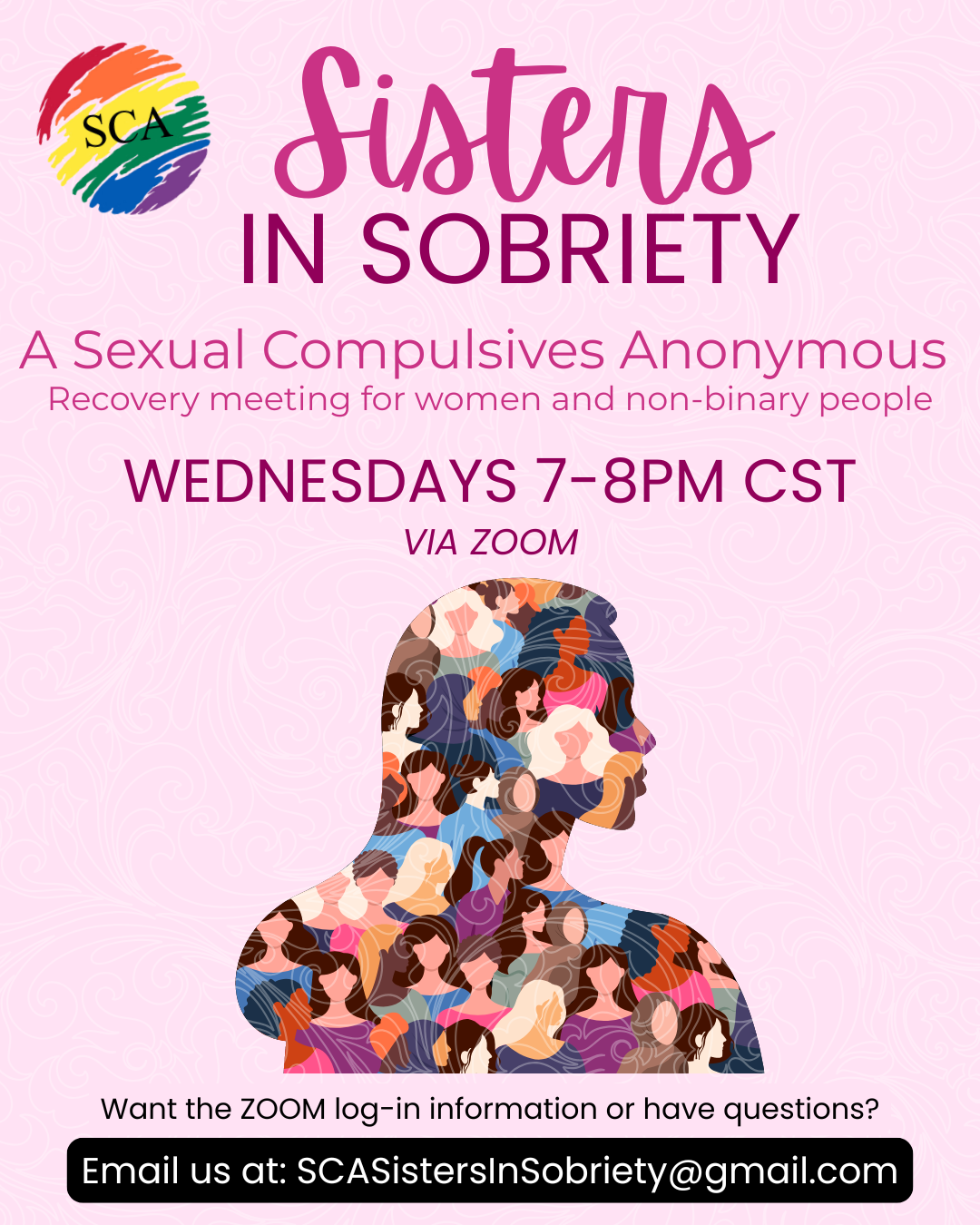
SCA Womans Meeting
Attraction rather than Promotion
SCA’s primary purpose and tradition is to carry it’s message to the sexual compulsive who still suffers. We are looking for help from anyone that may have internet experience with ways to ATTRACT those that may be interested or affected by CSBD (Compulsive Sexual Behavior Disorder) to our websites: SCAnneronline.org, https://www.youtube.com/@SCA-Recovery, SCA-recovery.org and our various Intergroups and WhatsApp meetings.
Please feel free to contact the SCAnner’s editor with any thoughts, ideas and suggestions.
The Problem of Porn Addiction
|
“I want my RTV (Recovery Television).”
SCA New York is pleased to announce its Spring Show “I want my RTV (Recovery Television).”
Performances will be held on Saturday, May 2nd, at 7pm and Sunday, May 3rd, at 3pm at the TADA! theater, 15 West 28th Street, near Madison Square Park.
Tickets are $35 plus online transaction fee.
To buy tickets, click this link:
|
|
Thanksgiving Gratitude Meeting
Please join us via zoom for 2025 SCA Los Angeles’ traditional Thanksgiving Gratitude Meeting.
Thursday November 27, 2025
10:00 AM – 11:00 AM Pacific Time
Zoom Meeting ID: 621 513 577
Password: 1234
Click here for meeting

Court Signatures will not be provided for this meeting.
International Meeting (in English)

Thursday online meeting mainly for European members, but all are welcome at 11 am Pacific Time, US; 2 pm Eastern Time, US; 8 pm Central European Time.
See https://sca-recovery.org/WP/meetings/europe-meeting-in-english/?tsml-day=4&tsml-region=virtual for more information.